Core Idea
Three quotations for the same project can differ by 30–40%. That is normal — usually because the suppliers are not quoting the same scope. The cheap one lists tracks and light modules only; the expensive one includes drivers, power feeds, connectors and end caps. Before comparing prices, compare the bill of materials. "Price per meter" is a marketing number. "Complete system cost" is an engineering number.
Why Comparing Unit Prices First Is Wrong
A track price alone tells you almost nothing. The same-looking 20mm rail can be built with pure copper or CCA conductors, 1.2mm or 0.9mm aluminum, anodized or powder-coated finish — and each choice changes the price. Drivers, power feeds, connectors, end caps and mounting hardware are separate line items, quoted only if your project needs them. Some buyers order rail only; others need the complete system. Before comparing prices, confirm exactly what each quotation covers.
As a market planning range, standard 48V magnetic track rail from China factories is often around US$5–10/m — with recessed, trimless or low-MOQ profiles (which carry tooling/setup cost) quoting above that. This is the rail only. Drivers, light modules, power feeds, connectors, end caps, mounting parts, packing and freight are separate unless the supplier clearly includes them. A low rail price is not a low system price if the supplier later adds expensive accessories or leaves out required electrical parts.
Budget a 48V system in two parts:
| Budget line | What it covers |
|---|---|
| System infrastructure per meter | Rail + allocated driver + feeds, connectors, end caps, mounting |
| Fully fitted meter | Infrastructure + the actual light modules — the real project cost |
What a Complete Quotation Should Include
A quotation is complete when every component your project needs appears as a line item. Not every order needs all of them — rail-only orders are common. Tick off only the lines your project requires:
| Component | What must be specified |
|---|---|
| Track rail | Series/SKU, 48V, cross-section drawing, installation type, length, finish, wall thickness, conductor material (pure copper / brass / CCA) |
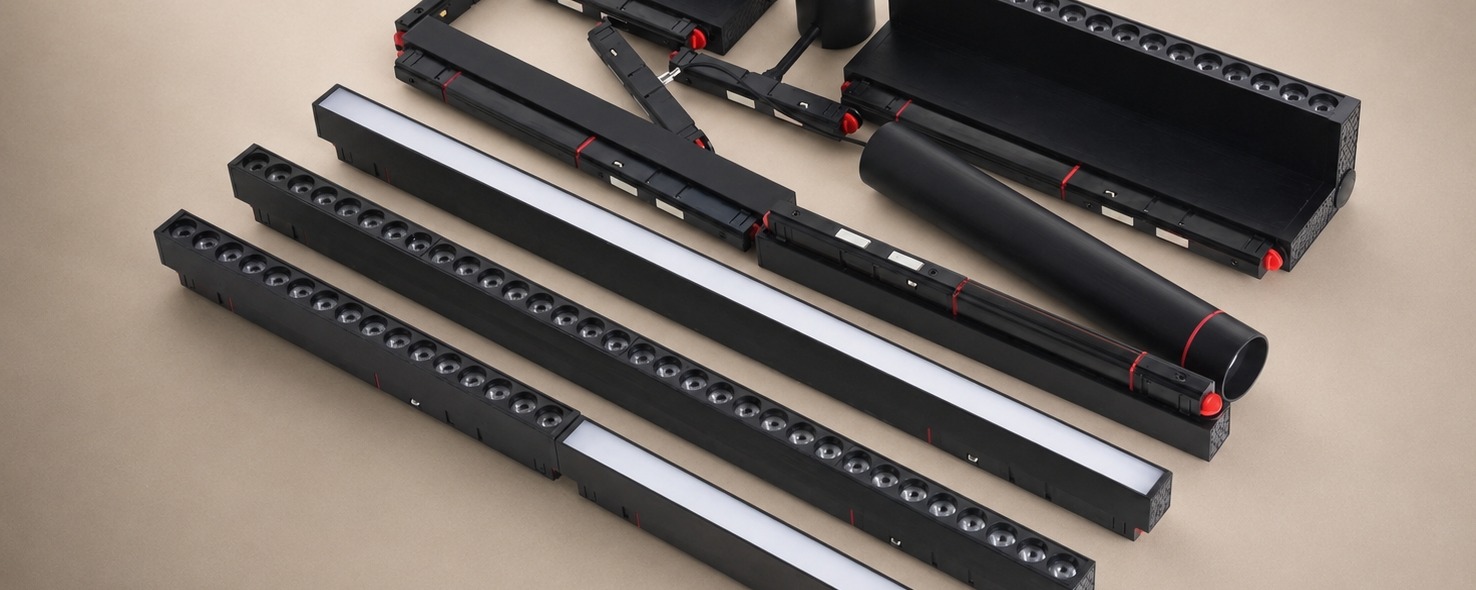
| Light modules | SKU, wattage, lumen output, CRI, CCT, beam angle, dimming version, finish |
| Driver | Brand, model, AC input, 48V output, wattage, dimming protocol, built-in or remote, warranty |
| Power feeds | Feed-in SKU, position (end/middle), cable length, terminal type |
| Connectors | Conductive vs mechanical — not interchangeable; straight, L, T as needed |
| Installation parts | End caps, mounting clips/screws, recessed/trimless accessories |
| Commercial terms | Unit price, MOQ, sample cost, OEM/tooling cost, packing, lead time, warranty, Incoterm |
Most common hidden omissions: conductive connectors, power feeds, end caps, mounting hardware, remote drivers, and enough feeds to prevent voltage drop.
A Worked Example: 20m Retail Run
A 20m retail run with 14 modules, two 100W drivers and full accessories:
| Line | Item | Qty (example) |
|---|---|---|
| A | 20mm surface track rail | 20 m |
| B | 10W spot modules | 8 |
| C | 18W grille modules | 6 |
| D | 100W 48V drivers | 2 |
| E | Power feeds (end) | 2 |
| F | Conductive straight connectors | 4 |
| G | End caps | 4 |
| H | Mounting clips | 40 |
Rail at US$5–10/m × 20m is roughly US$100–200. The complete system — with modules, drivers, feeds and accessories — is several times that. That gap is exactly what a complete quotation must itemise.
Why Prices Differ — And What You're Paying For
| Difference | Low-cost version | What the extra cost buys |
|---|---|---|
| Track conductor | CCA | Pure copper/brass — lower voltage-drop risk on long runs |
| Rail construction | Thin extrusion | Thicker profile, screw-fixed end caps, larger contact area |
| Installation profile | Surface | Recessed / trimless profiles cost more — engineered for the ceiling method |
| Module quality | "12W" on the label | Real lumen output, CRI ≥ 90, color consistency, glare control |
| Driver | Generic on/off | Reliable 0–10V / DALI / Casambi — and correct load matching |
| Order size | Standard MOQ | Low-MOQ carries tooling/setup cost; price per unit drops with volume |
| Accessories | Not part of the rail price | Live connectors, feeds and mounting kits add cost when your project needs them |
Three quality levels cover most distribution and project needs:
- Price-sensitive distribution
- Standard CRI, ON/OFF
- Retail, office, hotel projects
- Higher CRI, better anti-glare, dimming option
- Premium hospitality, design-led projects
- Premium finish, advanced control, documentation
As a practical guideline, total connected load should sit around 70–80% of driver rated power. For a 180W retail run, budget a 240W driver (or two suitably placed drivers) — not a driver at its nameplate maximum. Divide the shared components across the total track length, then add the actual modules.
The Quotation Template — Send This to Every Supplier
Copy this and send the same format to all shortlisted factories. Ask for SKU-level pricing, not a lump sum:
B. Modules: SKU / W / lumen / CRI / beam × qty × US$___
C. 48V driver: brand / model / W / dimming × qty × US$___
D. Power feeds: end / middle × qty × US$___
E. Conductive connectors: straight / L / T × qty × US$___
F. Mechanical connectors, end caps, mounting kits × qty × US$___
G. Total EXW/FOB, packing, lead time, warranty
H. Wiring diagram + load/voltage-drop calculation
If a supplier refuses to break down the quote, that is not a price problem — it is a transparency problem.
Five Checks Before You Accept Any Price
| Check | PASS | FAIL |
|---|---|---|
| Same electrical system | Track width, conductor position, contact structure and module series confirmed | "20mm" assumed compatible — it is not |
| Driver loading | Total load ≈ 70–80% of driver rating, calculation stated | One driver for every project, no calculation |
| Track conductor | Material and dimensions stated | CCA passed off as copper |
| Module performance | Lumen, CRI, beam and thermal structure specified | Wattage only |
| Scope confirmed | Every line your project needs is itemised; anything not included is stated | You cannot tell what the price covers |
Decision Output: If you cannot compare three quotations on the same BOM with SKU-level pricing, you are not comparing prices — you are guessing.
★ Tracklinear Judgment: A supplier is "fair" not because it is cheapest, but because its quotation, drawings and compatibility responsibility are clear enough that you can sell the system again without discovering new costs on the second order.
Keep Reading