Why That Cheap Magnetic Track Could Cost You More in the Long Run: 3 Hidden Quality Factors Every B2B Buyer Should Know
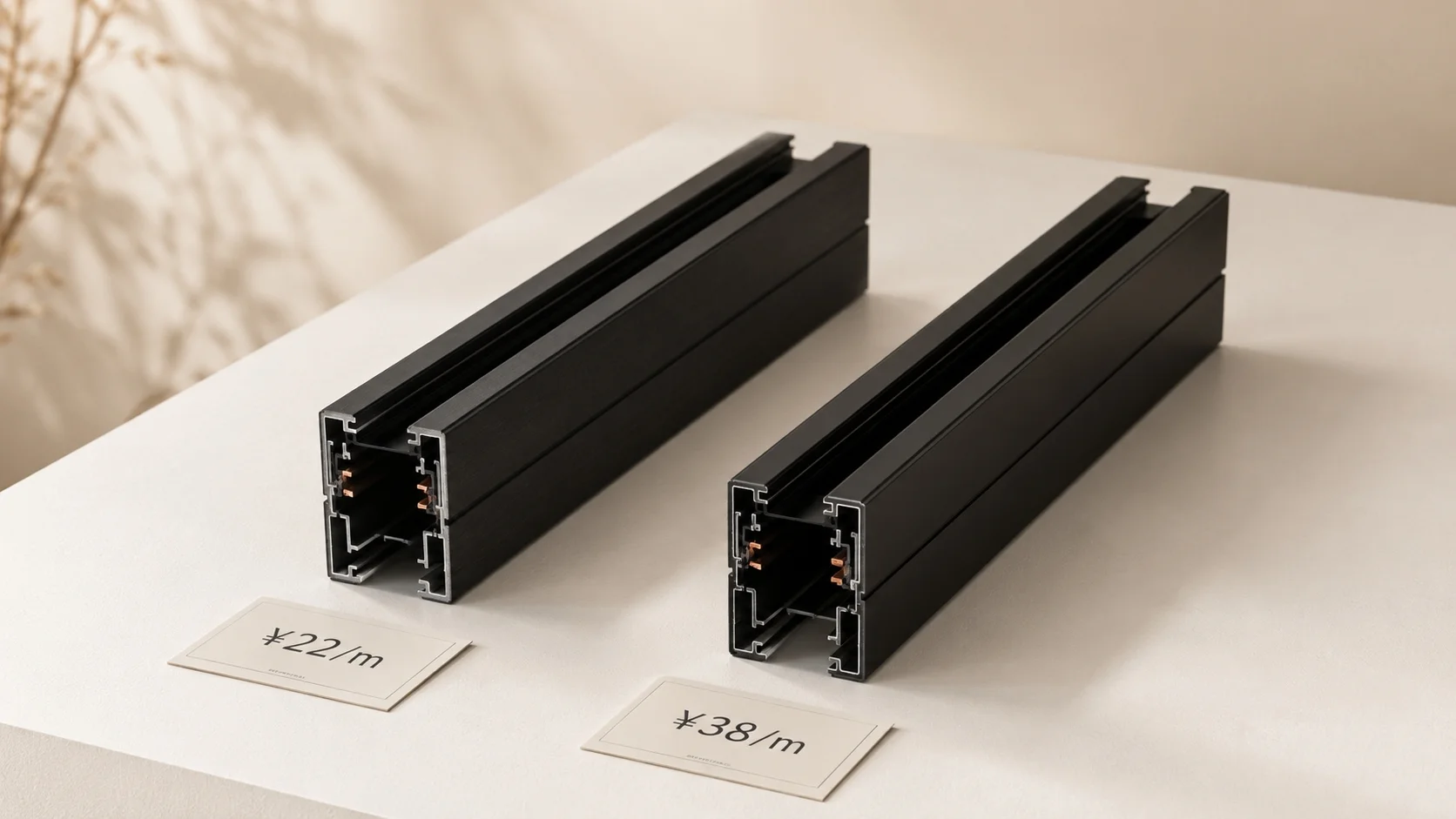
Quick Answer
Conductive strip material — CCA, brass, or pure copper determines voltage drop risk and contact durability.
Aluminum weight per meter — Heavier tracks (0.8–1.0 kg/m) use more material and perform better on long runs.
Surface finish — Anodizing gives premium metal质感; powder coating is more durable and cost-effective for most projects.
I've seen this happen more than once.
An importer finds a track at ¥22/m instead of ¥38/m. Saves about ¥1,600 on an order of 100 meters. Good margin, happy buyer.
Six months later, one of his customers calls. The lights at the far end of a 6-meter run are noticeably dimmer than the ones at the start. In another project, some modules lost contact after being repositioned a few times.
The importer ends up sending replacement track. Shipping, labor, lost trust — the total cost is more than the ¥1,600 he saved.
Not because the track was "bad." Because the price was telling him something about the internal quality that he didn't know how to read.
Here are the three things that decide whether a track will perform — and what to check before you order.
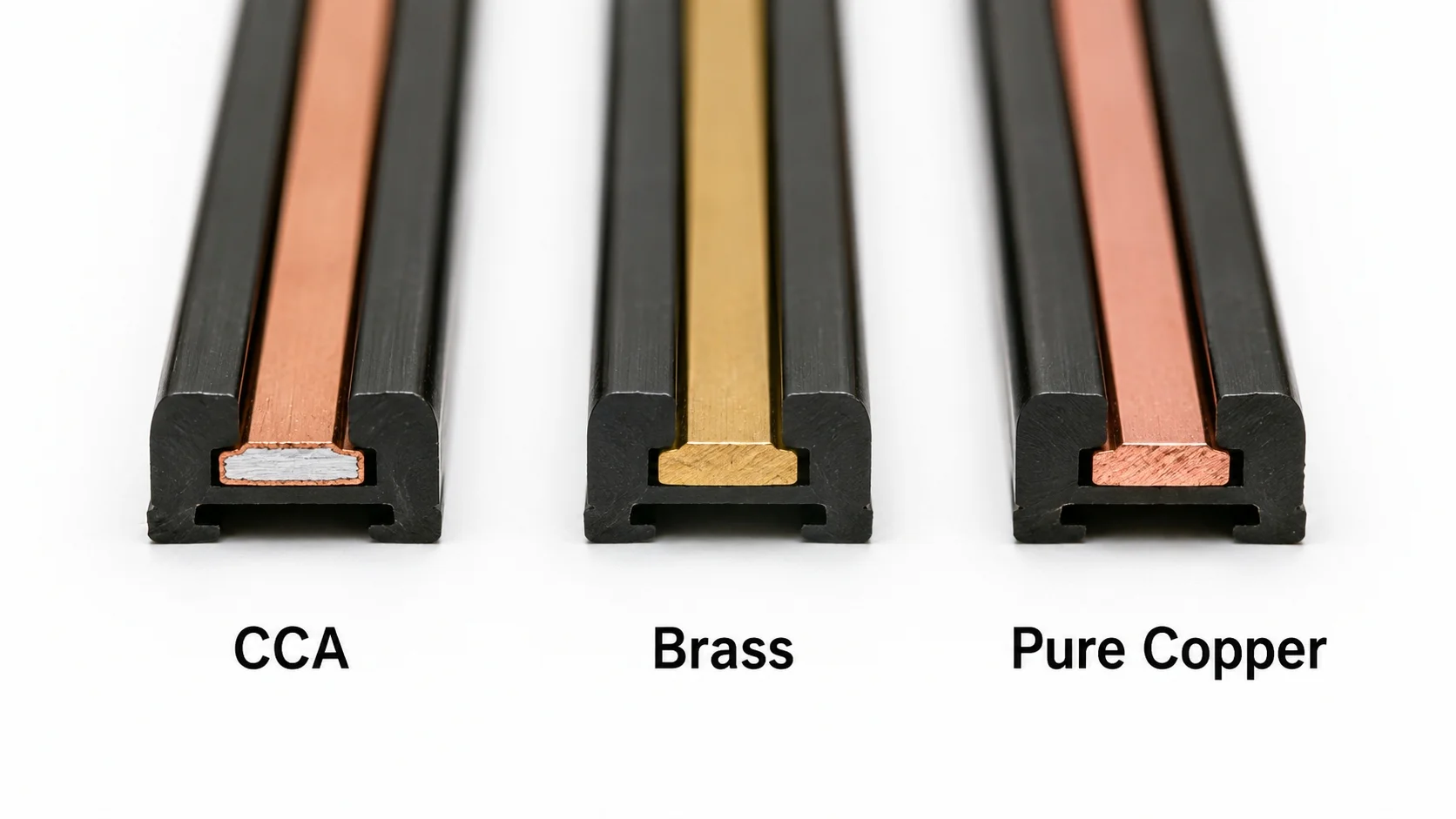
1. Conductive Strip: CCA, Brass, or Pure Copper
The conductive strip inside the track carries 48V power to every light module. It looks similar on all tracks. But the material makes a real difference.
CCA (Copper-Clad Aluminum) — An aluminum core with a thin copper layer. The most affordable option. On short runs with low load, it works fine. But on longer runs (over 4-5 meters), resistance builds up and causes voltage drop — the far-end dimming problem. And when modules are moved frequently, the thin copper layer can wear through.
Brass — Better conductivity, more durable contact surface. A standard choice for mid-range projects where the track will be adjusted after installation.
Pure copper — The best conductor. Lowest resistance, least voltage drop, most durable. Found in project-grade tracks where long-term reliability is expected.
A customer once asked me: "Why does your track cost more than the same-looking one from another supplier?" The answer was simple — their strip was CCA, ours was brass. Same shape, different material, different price.
What to ask your supplier: "What material is the conductive strip?" If they hesitate, it's probably CCA.
2. Weight Per Meter
Two tracks can look identical but weigh very differently. The difference is in the wall thickness — and wall thickness affects straightness, module fit, and long-term stability.
Common ranges I see in the market:
| Grade | Weight per meter | Typical use |
|---|---|---|
| Economy | 0.4–0.6 kg/m | Price-sensitive markets, short runs |
| Standard | 0.6–0.8 kg/m | General commercial, mid-range projects |
| Project-grade | 0.8–1.0 kg/m | Long runs, high-end commercial |
A heavier track costs more because it uses more aluminum. Not because the supplier is charging more for the same thing. If you compare two tracks at different prices, always compare the weight per meter first — it tells you more than the price alone.
3. Surface Finish: Anodizing vs Powder Coating
This is not about indoor vs outdoor. It's about the look you want the track to have.
Sandblasted anodized finish — The color becomes part of the metal. Premium feel, consistent texture, good scratch resistance. But costs 20-40% more because of the multi-step process (sandblasting + anodizing + coloring). Best when the track is visible and part of the design.
Powder coating — A durable painted layer. More color options (any RAL), better weather resistance, more cost-effective.
Not anodizing is always better, and powder coating is not always lower quality. I've seen powder-coated tracks that cost more than cheap anodized ones, simply because the pre-treatment and coating thickness were better.
What matters: Ask your supplier what process they use and why. If they can explain the difference clearly, they know their product.
Before You Place Your Next Order
You don't need to cut a track open to check its quality. These four checks work on a sample or at a showroom:
- Weigh it — Ask for the weight per meter. Compare, don't guess.
- Scratch the conductive strip — If silver shows under the surface, it's CCA, not pure copper.
- Run a fingernail across the surface — Anodized aluminum feels like metal. Powder coating feels like paint.
- Ask what's included — Does the price include end caps, connectors, and packaging, or just the bare rail?
Not sure which quality grade fits your market?
Send us your target price level and project requirements. We can recommend economy, standard, or project-grade track with matching modules and driver.
Send Your Requirements →